
To most of us, it is self-evident that we, as human beings and societies, should care about the environment and climate change. Greta Thunberg has, in a remarkable way, spurred political interest and engagement in climate change. This effort has affected our thoughts and emotions concerning environmental policy. However, when we dig deeper into the […]
Continue readingPage 21 of 50
Bioethics has a problem with human beings, the philosopher Roland Kipke writes. It must ask who belongs to our moral community. Who has rights? Who has human dignity? Who has the moral status usually attributed to healthy adult humans? Who has the right to life? The question is: Who belongs to us? Are human embryos […]
Continue readingEver since this blog started, I have regularly described how bioethical discussions often are driven by our own psychology. On the surface, the debates appear to be purely rational investigations of the truthfulness of certain claims. The claims may be about the risks of genetically modified organisms (GMOs), the private nature of genetic information, the […]
Continue readingIn popular scientific literature, research can sometimes appear deceptively simple: “In the past, people believed that … But when researchers looked more closely, they found that …” It may seem as if researchers need not do much more than visit archives or laboratories. There, they take a closer look at things and discover amazing results. […]
Continue readingBiobanks are getting bigger and the human biological samples that are stored in the freezers have increasingly long-term utility for research. The samples can be used not only in one study, but also in several different studies. Not only in today’s research, but also in future research. This creates research ethical tensions. Ethics requires that […]
Continue reading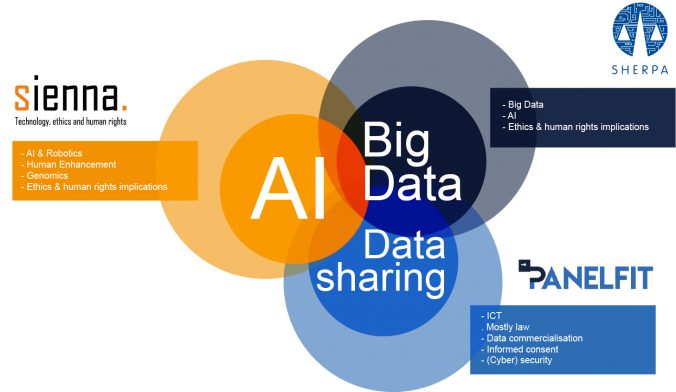
Do you use Google Maps to navigate in a new city? Ask Siri, Alexa or OK Google to play your favourite song? To help you find something on Amazon? To read a text message from a friend while you are driving your car? Perhaps your car is fitted with a semi-autonomous adaptive cruise control system… If any software or machine is going to perform in any autonomous way, it needs to collect data. About you, where you are going, what songs you like, your shopping habits, who your friends are and what you talk about. This begs the question: are we willing to give up part of our privacy and personal liberty to enjoy the benefits technology offers. Want to know more about the collaboration between SIENNA, SHERPA and PANELFIT? Read the editorial in Orbit (Setting future ethical standards for ICT, Big Data, AI and robotics: The contribution of three European Projects), or watch a video from our joint webinar on May 20, 2019 on YouTube (SIENNA, SHERPA, PANELFIT: Setting future ethical standards for ICT, Big Data, SIS, AI and Robotics).
Continue readingThe human is a miserable being. Although we are pleased about the new and better-paid job, we soon acquire more costly habits, richer friends, and madder professional duties. We are back to square one, dissatisfied with life and uncomfortable with ourselves. Why can life never be perfect? Discontent makes us want to escape to better […]
Continue readingPublic health focuses on the prevention of disease and the promotion of health on a collective level, that is, the health of the population. This distinguishes public health from medical care and the doctor-patient relationship. In a clinical setting, the doctor discusses treatments with the patient directly and risks and benefits are assessed in relation […]
Continue readingAllegedly, there are over 8.000 so called predatory journals out there. Instead of supporting readers and science, these journals serve their own economic interests first and at best offer dubious merits for scholars. We believe that scholars working in any academic discipline have a professional interest and a responsibility to keep track of these journals. […]
Continue readingWe need to do research to know what people think is important in genetic risk information. What they prefer to know. But how do we find out? One way is to ask people to answer questionnaires. One problem with questionnaires is that they ask one thing at a time. Do you prefer a hotel room […]
Continue readingTHE ETHICS BLOG
A research blog from the Centre for Research Ethics & Bioethics (CRB)
We write for researchers, healthcare staff, officials, politicians, patient organisations and anyone interested in ethics.
We comment on the research ethics and bioethics debate and discuss our own research. We address issues from current debates in the research community and in the press.
MEET THE EDITOR

Pär Segerdahl is editor of the Ethics Blog and Associate Professor of Philosophy at the Centre for Research Ethics & Bioethics.