A research blog from the Centre for Resarch Ethics & Bioethics (CRB)

Month: March 2026

Do you dare to be fearless?

Fear can easily play tricks on us thinking beings. When we are afraid of something, we often think that we should worry about it – so as not to lose control of it. So, to be on the safe side, we lie awake half the night thinking. We dare not let go of our thoughts, because they seem to watch over us as our personal guardian angels: as our private security service.

Another trick that fearful thoughts play on us is that they identify the cause of the fear with external factors that seem to make it reasonable to be afraid. It is difficult to be afraid of a simple stove if you do not constantly think about all the burns you would get if you put your hand on a red-hot stove. Through thoughts, fear creates its own claims to knowledge and its own worldview. Thoughts make fear appear realistic. People who do not share our fear are perceived as deceived and must be considered dangerous, because they risk leaving stoves on. Thus, fearful thoughts also motivate realistic safety measures: we do not visit strange kitchens without asbestos gloves. How fortunate that fear watches over us.

Another trick that fearful thoughts play on us is that they make us believe that we are safer if as many people as possible share our fear. Therefore, we try in every conceivable way to influence each other through the channels available to us. If necessary, we organize our own news channels, perhaps even our own security services, to protect us from all the evils that our trusted channels warn us about.

Daily contact with fearful thoughts makes it easy to identify with dramatic tales of a great struggle between guardian angels and dangers: between the forces of light and darkness. In the world of fairy tales, we identify with the guardian angels, or with the defenseless good people who must be defended by strong guardian angels. Since fear creates its own claims to knowledge and its own worldview, identification with the world of fairy tales can also encourage very dramatic safety measures against what we perceive as real threats. How wonderful to be able to stage the fight we read about in the fairy tales, where good-hearted fear triumphs over all the evils it is frightened by!

But does fear really know what we should be afraid of? Do we live in the frightening world that our guardian angels inform us about? Do we become safer by sharing our fear with as many people as possible? Or would the world be safer if we did not expose it to the tricks of our fear?

Here we can get a little worried, because surely, we should be afraid of something? Surely it must be reasonable to be afraid of what is truly dangerous? How can we realistically make the world safer if we do not get more people to share our well-founded fear? Is it not naive to believe that the deceived will voluntarily give up their distorted worldview? Therefore, well-founded information must be spread through trusted channels so that more people get involved in the fight against what is truly dangerous!

How can justified fear sound so similar to unjustified fear? Perhaps because in both cases the fear is framed by thoughts that tell us how justified it is. Feeling fear is natural and correcting false claims is important, but the tricks that fear plays on us thinking beings are artful and difficult to see through. For how can we examine our own security apparatus without engaging it again and letting it inform us about whether it constitutes a serious threat to our security?

Incidentally, there are other ways to read fairy tales, quieter reading experiences that make us familiar with how fear takes shape within ourselves.

Pär Segerdahl

Written by…

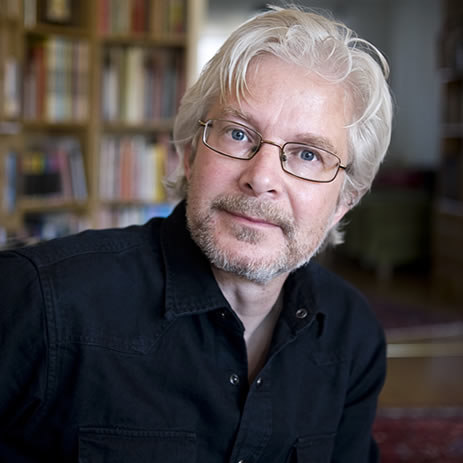
Pär Segerdahl, Associate Professor at the Centre for Research Ethics & Bioethics and editor of the Ethics Blog.

This post in Swedish

Thinking about thinking

How is ethical review perceived by researchers in the social sciences and humanities?

Research involving humans requires ethical review. Ethical review is important to protect the rights and interests of research participants, and to maintain public trust in research. Ethical review was originally developed for biomedical research where it is common to recruit patients as test subjects, for example in clinical drug trials. In Sweden, a central authority is responsible for ethical review, the Ethical Review Authority. In order to conduct research involving humans and sensitive personal data, researchers must first apply for permission from the authority. Researchers who violate the Act on Ethical Review of Research involving Humans can be prosecuted and sentenced to a fine or imprisonment.

Social sciences and humanities are also covered by the Act on Ethical Review. However, it has been questioned whether the requirement for ethical review is relevant for these academic disciplines where humans are not normally recruited as test subjects. However, even here, empirical research involving humans occurs, and the methods used can affect and harm the people in the studies. Furthermore, sensitive personal data is often used in the research. If such aspects justify ethical review of biomedical research, they should also justify ethical review of research in the social sciences and humanities.

At the same time, it should be remembered that research is conducted differently in different scientific fields. For example, research in the social sciences and humanities is usually conducted in a more exploratory and inductive manner than in biomedicine. Aims, questions and methods can be modified during the course of the research work, as data is collected and analyzed. It can therefore be difficult for researchers in these disciplines to provide sufficiently specific information about aims, questions and methods in their ethics review applications. Furthermore, in the social sciences and humanities, researchers often work with publicly available personal data: they may have appeared in newspapers. Do researchers have to apply for ethical permission to conduct research on sensitive personal data that anyone can access, such as opinions expressed in debates in the media?

The requirement for ethical review in the social sciences and humanities has been debated and questioned by representatives of these disciplines. It is therefore valuable to empirically examine researchers’ perceptions of ethical review. Do the critical opinions in the debate have broader support among researchers? Together with three co-authors, William Bülow reports on an interview study with 18 Swedish researchers in business, language, history, political science, sociology, gender studies, religious studies and other disciplines within the academic domain. The article is published in the Journal of Academic Ethics. Questions that were sought to be answered were how researchers believe the ethical review system works within their academic disciplines, what advantages and disadvantages researchers experience with the system, and how they believe it can be adapted for research in the social sciences and humanities.

The interviews revealed a broad spectrum of experiences and perceptions. Some considered it an advantage that research projects are ethically reviewed by an external authority that has the necessary expertise, infrastructure and independence. Others saw it as a disadvantage that researchers, faculties and universities were deprived of their personal and collegial ethical responsibility. Does one not take deeper ethical responsibility by continuously discussing one’s research with colleagues, for example at the research seminar? Many of those interviewed described the difficulties that researchers in the social sciences and humanities may experience when they have to specify the research in advance in the application form, since aims, questions and methods can be modified during the work. Some described how they had to find a balance between providing the specific information required in an ethics review application and leaving room for the changes in the design that the research itself may require.

A recurring theme in the interviews was that the application form was too focused on biomedical research with human test subjects. Many of the questions in the form were perceived as irrelevant and almost unanswerable. For example, forms were requested that were better adapted for document studies. Many also experienced a lack of guidance and support from the Ethical Review Authority when filling in the form. Others, however, considered that such criticism of the form and the support from the authority was exaggerated.

The system of ethical review also gave rise to emotions. For example, fear of making mistakes in the ethics application that lead to losing important research time, or concerns about whether researchers are allowed to use publicly available personal data without applying for ethical permission. Some stated that colleagues could opt out of empirical research to avoid these uncertainties that the system could create. Some considered it unreasonable that they, as researchers, could be sentenced to fines or imprisonment for not following the Act on Ethical Review. An important theme in the interviews was that the system of ethical review can influence researchers’ choice of questions, materials and methods in order to avoid perceived uncertainties about ethical review.

In their discussion, the authors argue that the interview results speak against some of the objections that representatives of the social sciences and humanities have directed at the Swedish system of ethical review. For example, it has been argued that regulation can lead to de-professionalization, where researchers no longer take ongoing responsibility for ethical problems that arise in their research work. Although such concerns were expressed in the interviews, others emphasized that, on the contrary, there were very lively discussions about research ethics at their institutions and that the legal requirement for ethical review has increased awareness of research-ethical issues.

A particularly problematic interview result, according to the authors, is that fear and uncertainty about the requirement for ethical review, reinforced by the risk of legal action such as fines and imprisonment, can influence researchers’ choice of questions and methods. There is a risk that questions that one is genuinely curious about are investigated to a lesser extent, or with less empirical depth, in order to avoid the requirement for ethical review. In short, important research risks not being carried out if researchers choose more theoretical approaches or limit their material and questions to avoid perceived uncertainties about ethical review.

Overall, the interview results do not speak against the Swedish ethical review system, according to the authors. However, the results indicate that certain aspects of the system may need to be improved and adapted to the social sciences and humanities. The Ethical Review Authority probably needs to make the application process and form more flexible to suit different scientific fields. The authority probably also needs to consider better support for researchers who are unsure about the application process or the ethical requirements that apply to research in the social sciences and humanities.

For more results and the authors’ discussion, read the article here: Experiences of Ethical Review: Perspectives of Swedish Researchers in Social Science and Humanities.

Pär Segerdahl

Written by…

Pär Segerdahl, Associate Professor at the Centre for Research Ethics & Bioethics and editor of the Ethics Blog.

Bülow, W., Johansson, M., Persson, V. et al. Experiences of Ethical Review: Perspectives of Swedish Researchers in Social Science and Humanities. Journal of Academic Ethics 24, 35 (2026). https://doi.org/10.1007/s10805-025-09702-3

This post in Swedish

We recommend readings